
Kids' closets
A kids' closet designed for the child who uses it.
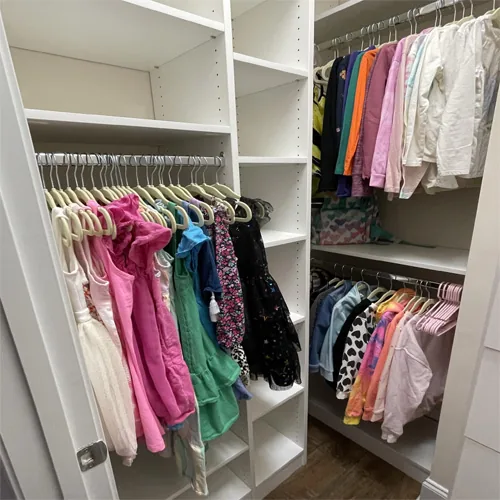
Your designer starts with your child: their height, their routine and what they can put away on their own. The rods and shelves then move up as they grow.
How your designer starts
Every project begins in your home, with questions before measurements. The answers decide the layout. For kids' closets, your designer will ask:
- How old are your kids, and do they need low rods?
- What ends up on the floor most days?
- Does one child use the closet, or do siblings share it?
- What do you want kept up high, out of reach?
Who you work with
Your space is designed by a named person, not a sales team: owner Jessica Behnke, who has designed and installed closets since 2014, or design consultants Alexa Behnke and Jeanette Sabino. The same team sees your project through from the in-home visit to the final walkthrough, and installer CJ Del Greco builds it.
In a client's words
“From first communication to completion of install, I have been so impressed and pleased with my Closet Design Twins experience! The design team is responsive and thorough at every stage and I felt like my project was a true priority. The …”
Quick answer
Closet Design Twins designs kids' closets around the child who uses them. A named designer visits your home, asks about your child's age and routine, and plans low rods, reachable drawers and shelving that moves up as they grow. You see the design in 3D before you commit, and our own crew installs it.
Why Closet Design Twins
Anyone can put up shelves. You are paying for the layout.
Layout comes first
Closet companies buy the same boards. What you pay for is a layout where everything you own has a place.
We ask before we draw
We never open with "what do you want?" We ask how you get ready, what you own, and what is not working.
A designer who stays
The designer who visits your home plans your space and stays your contact through the final walkthrough.
It changes as you do
Adjustment holes run the full height of each panel, so rods and shelves move as your needs change.
Built to hold up
Panels are 3/4" thick, with a fixed shelf in each section for stability and a Limited Lifetime Warranty.
Fair upgrade prices
Better drawer fronts, hampers, and hardware should be within reach, so we do not load them with markup.
Independence is the design brief
A kids' closet works when a child can put things away without help. That means hanging rods low enough to reach, drawers they can open, and a clear place for the things that always end up on the floor. Higher shelves hold what the parents manage: out-of-season clothes, keepsakes and the next size up.
Read moreShow less
Plan for the next five years
Children change faster than any other room in the house. We design with adjustable shelving and rods that can move up, so the same system works for a five-year-old and a twelve-year-old. Bins on upper shelves turn into book and hobby storage later. Nothing about it should need tearing out.
Read moreShow less
Shared rooms and siblings
When two children share a closet, clear territory matters. Split hanging, matched drawer stacks and labeled bins give each child their own side, which cuts down on morning negotiations. We will ask about this on the design visit.
Read moreShow less
Heights by age
For young children, put one hanging rod where they can reach it and a second, higher rod for out-of-season or next-size clothes that parents manage. Low drawers or bins hold everyday basics. As they grow, the low rod moves up and the bins become book and hobby storage.
Read moreShow less
Labels, bins and routine
Simple labels or picture tags on bins help younger children put things back without asking. A hook at their height for tomorrow's outfit or a backpack turns the closet into part of the morning routine instead of a place things disappear.
Read moreShow less
From the portfolio
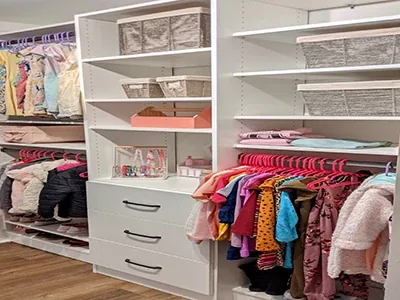
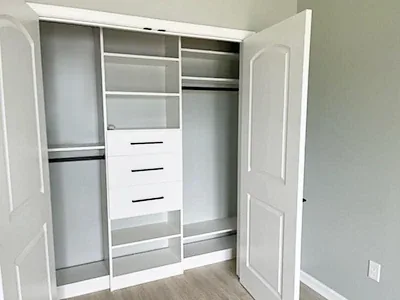
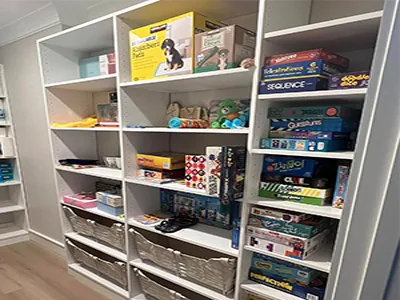
Real kids' closets by Closet Design Twins. Open the full portfolio to filter by room.
Related rooms
Why it is worth doing well
A closet a child can use alone gives you back time every school morning. Because the rods and shelves move, the same system works at five and at fifteen, so you only design it once. The shelving and rods adjust, so the system keeps working as your needs change, and it carries our Limited Lifetime Warranty.
Every project includes
- A complimentary discovery call and in-home design visit
- Your layout drawn in 3D, so you see it before you commit
- A price that is fixed before any work begins
- Installation by our own crew, not a subcontractor
- A final walkthrough, and shelving you can adjust later
Before your design visit
In short: rough measurements, a count of what you hang and fold, and a list of what bothers you now make the in-home visit faster and the design better.
Measure the walls
Measure the walls you want to use. Width of each wall, ceiling height, and the depth of any reach-in from the back wall to the door frame. Rough numbers are fine; we measure precisely on the visit.
Note doors and windows
Note doors, windows, vents and switches. Door swings, window sills, HVAC returns, light switches and attic hatches all decide where shelving and drawers can go.
Count what you hang
Count what you hang. Roughly how many shirts, dresses and long coats, and who shares the space. Hanging length is the biggest single driver of layout.
Count folds and shoes
Count what you fold and where shoes live. Folded items point to drawers or shelves; shoes and bags point to angled or flat shoe shelving at eye level.
List what bothers you
List what bothers you now. The pile on the chair, the shelf you cannot reach, the things you keep rebuying. Frustrations are the best design brief.
Collect a few photos
Collect a few photos you like. Two or three images help us talk about finish, hardware and mood. They are a starting point, not a template.
The build, for the record
Good design needs good materials behind it. This is what we build with.
Kids' closets: key facts
- Built for
- Toddlers through teens
- Key move
- Rods and drawers at the child's reach
- Grows with them
- Adjustable shelving, rods that move up
- Material
- 3/4" thermally fused laminate, 38 finishes
- Price
- Quoted after the design visit
See every front, color, and accessory on the design options page.
Questions about kids' closets
At what age is a custom kids' closet worth it?
Any age, if the system can adapt. Because our shelving and rods adjust, a closet designed for a toddler can be reconfigured as they grow instead of replaced.
Can kids' closets match the rest of the house?
Yes. Kids' closets use the same 38 finishes and hardware as every other CDT system.
Complimentary consultation
Start with a conversation, not a catalog.
Book a complimentary discovery call. We will ask how you live, then design the space around it in 3D before you commit. Email hello@closetdesigntwins.com or call (954) 598-1664.